Obturator Internus: Muscle, Channel & Acupuncture Technique
Module II: The Low Back, Hip and Groin course Assessment and Treatment of Injury of the Sports Medicine Acupuncture Certification Program is coming up June 5-8 at VUIM in Vienna, VA (completed) and July 10-13 at Marina Village Conference Center, San Diego, CA. The June 19-22 class in San Diego, CA is at waitlist!
In this article, we feature acupuncture and channel points for the obturator internus (OI), which is a primary muscle for pelvic floor function and hip joint pathology.
The obturator internus (OI) suspends the pelvic floor from the lateral sides via the tendinous arch and is important in keeping muscle balance between left and right sides. This muscle has a strong action in external rotation of the femur when the hip is extended and can abduct the femur when the hip is flexed.
It is a good muscle to include in patients with hip joint arthrosis conditions because the OI plays a major role in stabilizing the hip joint. It is an important to link the OI with adjacent and distal points that communicate with this myofascial tissue.
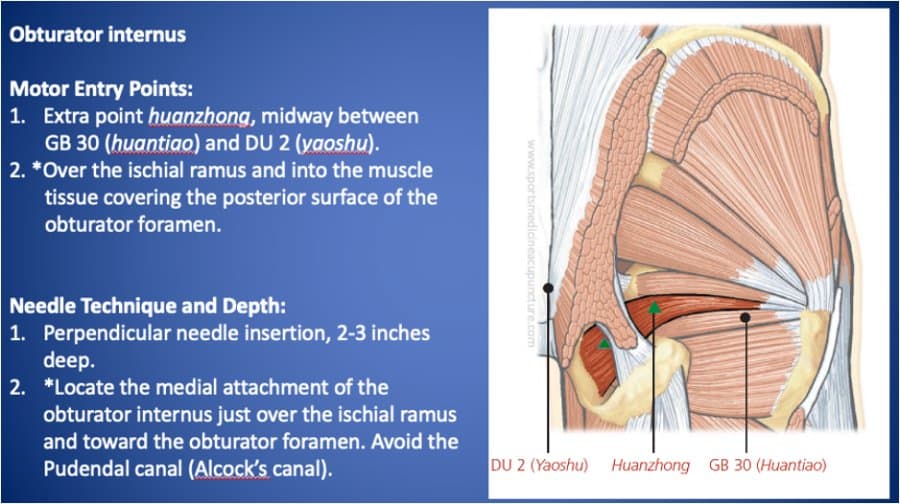
Below are a few Powerpoint slides from the upcoming Module II seminar that describes this muscle, as well as a video presenting one of two needle techniques for the primary motor entry points. This video shows the location and needle technique for the medial motor entry point of the obturator internus (OI).
The second needle technique for the lateral motor entry point is to needle the extra point Huazhong located at a point halfway between the medial one-third of a line joining the hiatus of the sacrum (DU 2) and GB 30 (huanzhong). A 3-inch needle is inserted perpendicular-oblique into the obturator internus (OI) with the needle angled medial and perpendicular to the spine.