
CASE STUDY: Misdiagnosed Plantar Fasciitis Pain (Inferior Calcaneal Nerve Entrapment or Baxter’s Neuropathy)
This case study details a presentation of heel pain misattributed to plantar fasciitis that was later correctly diagnosed as inferior calcaneal nerve entrapment (Baxter’s Neuropathy).
An 80-year-old male reported having plantar heel pain that started the day after he landed precariously onto his right foot after missing the last rung of a ladder. The patient did not feel any pain at the time of the accident but felt increasing discomfort when taking his daily walks.
He went to his primary physician and was diagnosed with plantar fasciitis and prescribed four weeks of physical therapy (PT). The pain continued to get better with PT, but never completely resolved. Once the allowed PT visits were completed, the pain eventually came back to the same intensity as before from when the initial injury had occurred.
As a rule, when a patient complains of plantar heel pain with signs and symptoms of plantar fasciocis (PF), a more accurate description of the condition, the practitioner should rule out another source of heel pain located in the same area as PF. A soft tissue nerve entrapment of the inferior calcaneal nerve (ICN) between the abductor hallucis and quadratus plantae muscles can generate plantar heel pain and mimic PF or co-contribute to the existing PF pain patterns. Pain from PF is usually located where the central plantar aponeurosis attaches to the medial calcaneal tuberosity. (Fig. 1)

Figure 1. Yellow circle indicates pain area from plantar fasciocis and inferior calcaneal nerve entrapment.
The inferior calcaneal nerve is also referred to by several names, including the deep calcaneal nerve, nerve to the abductor digiti minimi, and Baxter’s nerve.
Entrapment of the inferior calcaneal nerve was first reported in 1940 by Roegholt and was subsequently confirmed by many researchers (Llanos LF, 1999). Donald E. Baxter, who further described the condition in 1984 renamed the nerve and the condition as it is now commonly referred to as Baxter’s neuropathy, although the nerve and condition was documented earlier in the medical literature (Prem, A. 2023)
Assessment for Inferior Calcaneal Nerve Entrapment (Baxter’s Neuropathy):
-
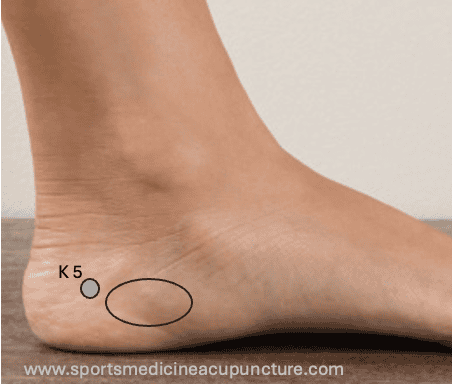
Figure 2: Oval indicates region anterior to acupoint K 5 for digital tapping examining for inferior calcaneal nerve entrapment.
Clinical Exam: Perpendicular digital tapping on the involved tissue of the nerve entrapment region (Tinel’s Sign). The area to tap is in a region anterior to K 5 (Fig. 2).
- PF is worse with the first streps out of bed and (ICN) entrapment generally does not have pain until later after activity and increases in pain throughout the day from use.
- MRI can visualize the anatomy and identify signs of nerve entrapment. If the entrapment is chronic, atrophy and fatty infiltration of the abductor digiti minimi (ADM) muscle can be observed. The inferior calcaneal nerve innervates the ADM muscle.
- Pes planus (foot over-pronation) is commonly found with this condition. Examine for Helbing’s sign.
Local Acupuncture Needle Technique:
Using the classical needle technique Pang Ci, the practitioner inserts two 1.5 inch/40 mm needles into two different points with the needles angled toward each other so that the tips converge at injury site i.e. plantar aponeurosis attachment on the medial tubercle of the calcaneus (Fig. 3B) and the soft tissue entrapment site of the abductor hallucis and quadratus plantae (Fig. 3A). The insertion site of this needle is predicated on the location of the positive Tinel’s sign.
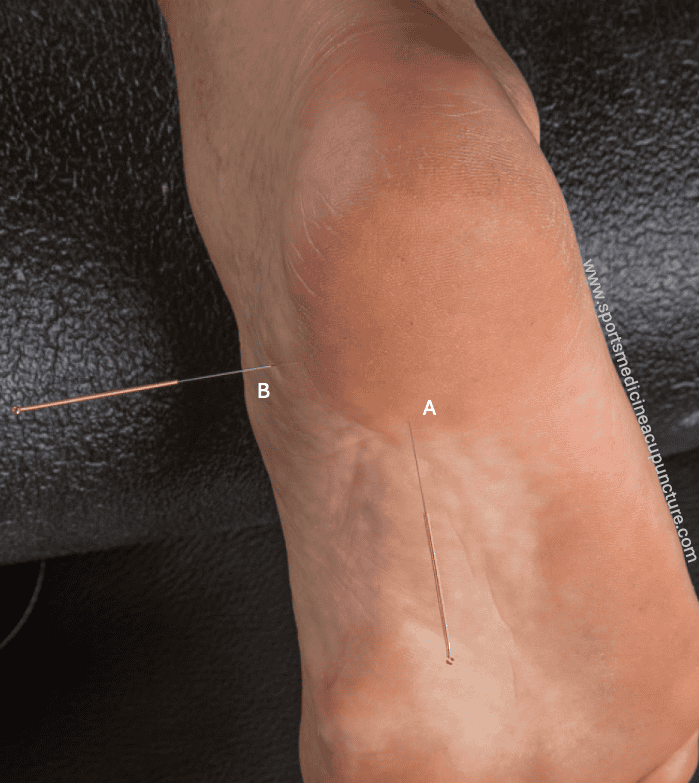
Figure 3 A and B: Pang Ci local needle technique for plantar fasciocis and inferior calcaneal nerve entrapment pain patterns.
This article is describing the local acupuncture treatment for this condition and the practitioner will need to combine this local technique with adjacent and distal needling, myofascial techniques, etc. for a more comprehensive treatment protocol.
References:
For more information on the assessment and treatment of injuries like Baxter’s Neuropathy, check out the courses in the Sports Medicine Acupuncture Certification Program. This program was developed by acupuncturists for acupuncturists.
About the author(s):

Matt Callison is the president of the Sports Medicine Acupuncture Certification program. He has been combining sports medicine and traditional Chinese medicine (TCM) for over 26 years. He is the author of the Motor Point and Acupuncture Meridians Chart, the Motor Point Index, The Sports Medicine Acupuncture textbook and many articles on the combination of sports medicine and TCM.
About the author(s):
Matt Callison is the president of the Sports Medicine Acupuncture Certification program. He has been combining sports medicine and traditional Chinese medicine (TCM) for over 26 years. He is the author of the Motor Point and Acupuncture Meridians Chart, the Motor Point Index, The Sports Medicine Acupuncture textbook and many articles on the combination of sports medicine and TCM.