
LU 3 and LU 4 Acupoints, Innervation & Clinical Applications
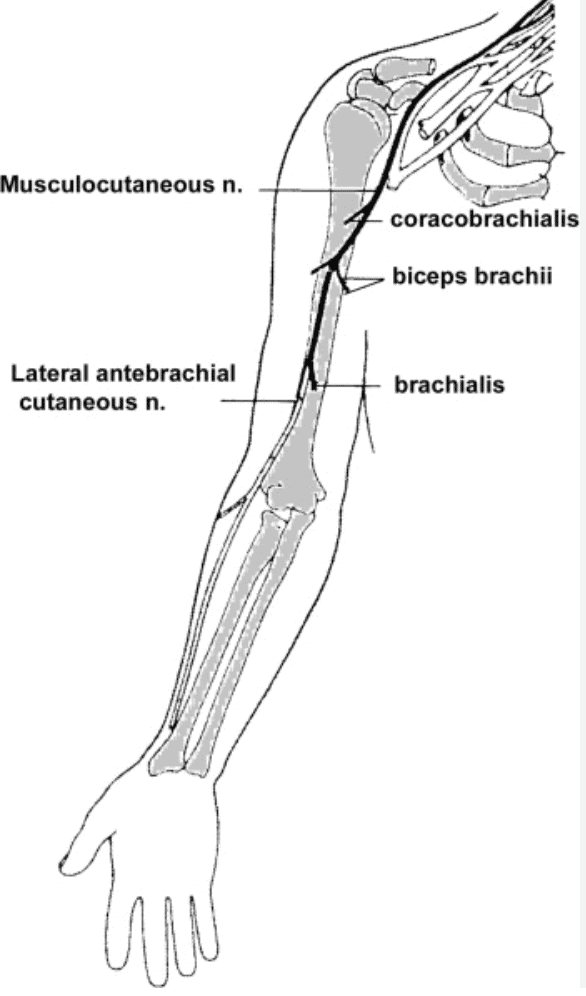
Fig. 1. The musculocutaneous nerve and lateral antebrachial cutaneous nerve. Image: Ferrante, M. A. (2012). Electrodiagnostic assessment of the brachial plexus. Neurologic clinics.
This article draws from research and development from AcuSport Education’s cadaver dissection taught in the Sports Medicine Acupuncture Certification program. This article aims to identify the tissue innervations of acupoints LU 3 and LU 4, determine when to use these points, and offer suggestions on needle technique and depth. These points are often underused by the modern-day acupuncturist.
LU 3 and LU 4 Acupoints Anatomy
These points are innervated by the musculocutaneous nerve (MCN) (Fig. 1). This nerve stems from spinal roots of C5-C7, therefore C4-C6 Huatuojiaji (HTJJ) points are used to affect these spinal nerve roots. The MCN travels along the Pericardium channel in the upper arm and migrates distal and laterally to the Lung channel in the lower aspect of the upper arm. It stems from the lateral cord of the brachial plexus and is the motor innervation for the biceps brachii, coracobrachialis and brachialis. These myofascial tissues, we have categorized into the LU sinew channel.
The musculocutaneous nerve, located just proximal to the elbow travels superficial from the muscle layer and turns into the lateral antebrachial cutaneous nerve, which provides sensory innervation to the lateral side of the forearm along the Large Intestine (LI) channel.
Location & Tissue Innervation of LU 3 and LU 4 Acupoints
There are a couple of different locations for these points from resources gathered including older and modern-day acupuncture texts. All resources agree these points are located 3 cun (LU 3) and 4 cun (LU 4) inferior from a level line drawn from the anterior axillary fold. One location of these points is described as in the space between the muscle tissue and humerus (lateral intermuscular septum) and other sources describe the points slightly more anterior into the lateral muscle tissue. Anatomically, the second location is where the MCN has two nerve anastomoses branches inserting into the biceps long head muscle on the posterior and medial side of the muscle. These are the motor entry points that share the same locations as the LU 3 and LU 4 acupoints. From our dissections, the lower anastomosis branch has been found at LU 4 or slightly distal by 0.5 cun from LU 4. (See Note below)
In this video (only viewable on YouTube due to the age restriction), LU 3 and LU 4 acupoints and their nerve innervations are shown on a cadaver specimen. This is followed by a demonstration of point location and needle technique is on a live model.
Conditions
LU 3 (Tianfu) is classically a “Window to Heaven” point, which is a category of points used for mental-emotional disorders and acute conditions of the neck and head. It is also a useful point for acute emotional upset as it promotes a calming effect especially when combined with other points (see Point Combinations) P 6 and SP 6. In addition, the author finds it useful for headaches especially from high blood pressure, combine LU 3 with GB 41 and LIV 2 or 3.
LU 4 (Xiabai) is classically used for asthma, excessive cough and shortness of breath. Clinically, this point will often have greater deqi sensation with less needle manipulation than LU 3. From our observations in cadaver dissection, the anastomosis branch off of the musculocutaneous nerve into LU 4 is often found to be a larger diameter nerve compared to LU 3, resulting in more motor and sensory fibers and a stronger deqi sensation.
LU 3 and LU 4 are the bicipital longhead motor points and have a strong effect on pain and discomfort affecting the LU channel such as with bicipital long head tenosynovitis and superior glenoid labral injuries (where the bicipital long head tendon inserts into the superior labrum e.g. SLAP injury). In addition, because the musculocutaneous nerve turns from motor to sensory, these points are also effective as adjacent points for treating C5-C6 radicular pain, which often affects the LI channel of the forearm.
LU 3 and LU 4 Acupoints Needle Technique & Depth
With the patient supine, perpendicular oblique needle insertion into the lateral border of the biceps long head muscle, 0.5-1 inch in depth.
Point Combinations
Pain affecting the LU channel such as bicipital strain or tenosynovitis, anterior shoulder pain, dequervain’s tenosynovitis, LU 6 (xi-cleft), LU 7 (luo-connecting). This combination can also be used for pain in the antagonist myofascial tissue such as Triceps strain or tenosynovitis.
Calming the mind P 7 (yuan-source), HT 7 (yuan-source), LIV 3 (yuan-source) Headaches (excess in nature) GB 41 (shu-stream) and LIV 2 (ying-spring) or LIV 3 (yuan-source).
Note: Nerve diameter can have different sizes in circumference, and their innervation location can vary. Not every acupuncture point is in the same location from human to human.
About the author(s):

Matt Callison is the president of the Sports Medicine Acupuncture Certification program. He has been combining sports medicine and traditional Chinese medicine (TCM) for over 26 years. He is the author of the Motor Point and Acupuncture Meridians Chart, the Motor Point Index, The Sports Medicine Acupuncture textbook and many articles on the combination of sports medicine and TCM.
About the author(s):
Matt Callison is the president of the Sports Medicine Acupuncture Certification program. He has been combining sports medicine and traditional Chinese medicine (TCM) for over 26 years. He is the author of the Motor Point and Acupuncture Meridians Chart, the Motor Point Index, The Sports Medicine Acupuncture textbook and many articles on the combination of sports medicine and TCM.